Magical places and the local patch
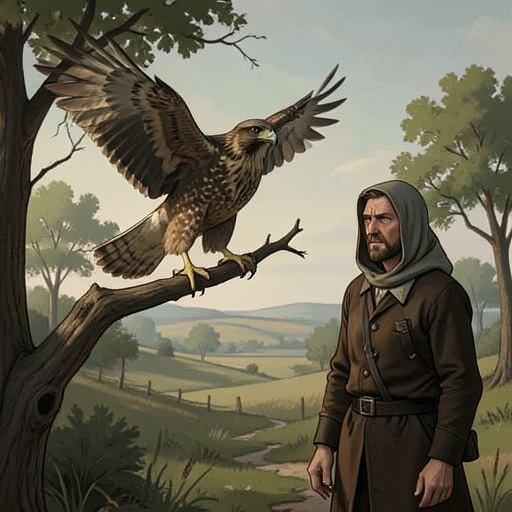
H is for HawkMagical places and the local patch names a way of inhabiting landscape in which particular places gather meaning through repeated visits, remembered events, and close attention to living things. For Helen Macdonald, the hill where she flies Mabel becomes more than terrain: it is a map assembled from knowledge of animals and paths, while Mabel independently begins to build a map of her own. Their increasingly coincident routes make the landscape at once personal, natural-historical, and shared.
A landscape learned by attention
Macdonald does not own the land where she flies; she has permission to use it. Yet walking it repeatedly and attending closely to its details makes it hers in a different sense. Her knowledge is specific and practical: she can distinguish the hedgerows and tracks through dry grass, notice where European hares cross field boundaries, and recognize earths, warrens, trees, and rusted machinery. The route itself changes in character as it climbs, passing fenced mud marked by tyre tracks, sheep pasture, a mown clover ley, and mugwort whose seed heads cling to frost-killed stems. Higher up, the track narrows into grass among cow parsley, knapweed, and wild burdock, with chalk beneath the clay.
This familiarity includes knowledge of how animals respond to conditions. Larks sleep at the top of the hill but move to its east-facing slopes on sunny mornings. After wet weather, when the rain has stopped, rabbits in warrens near the ditches move east to graze on drier fields. Macdonald’s sense of where an animal may be comes not from seeing it in advance but from experience combined with clues she has registered almost unconsciously: sunlight on stubble, the pressure of wind, and the exact colour of the ground. She moves towards the larks as if she could see them. The local patch is therefore not simply a location known by name or outline; it is a place read through accumulated attention.
Childhood waypoints and the pull of return
The hill’s meaning has a counterpart in Macdonald’s childhood, when the world was understood through separate, particular places. Asked to draw a map of the fields she roamed as a child, she could not do it. Asked instead to list what was there, she could fill pages: a wood ants’ nest, a newt pond, an oak bearing marble galls, and birches beside a motorway fence with fly agarics at their feet. These were the waypoints of her world, held in memory as encounters rather than arranged into a surveyable map.
Some places became magical through an accidental discovery. After Macdonald found a large red underwing moth behind an electricity junction box, she felt compelled to check behind it on every subsequent walk, though nothing was there again. She also ran to the place where she had once caught a grass snake and looked up at a tree that had held a roosting owl one afternoon. Their continuing pull did not depend on repeated sightings. The place retained the force of what had happened there, even when later visits offered no new proof of life. Such spots made a landscape into a personal archive whose entries were attached to particular corners of ground.
Events written into the hill
The fields where Macdonald flies Mabel accumulate another kind of memory: a shared history made out of specific incidents. One tree marks the place from which Mabel dived and struck Macdonald on the head. A line through the air recalls the first time Mabel followed a male Pheasant into cover. A hedge holds the memory of the hawk clinging to its branches, tail fanned and wings pressed against the twigs, searching for a pigeon that had already gone. A bramble bush recalls the moment it tripped Macdonald and pitched her into a flooded ditch.
These traces complicate the idea that a landscape’s ghosts must belong to the distant past. Macdonald’s ghosts are not long-dead falconers but the remembered events themselves. The places remain recognizable because action has marked them in memory: a tree is also the site of a blow, a hedge the site of a failed search, and a bramble the cause of a fall. The local patch is thus built not only from natural features and animal habits but also from the history of what has happened between human and hawk.
Mabel’s emerging map
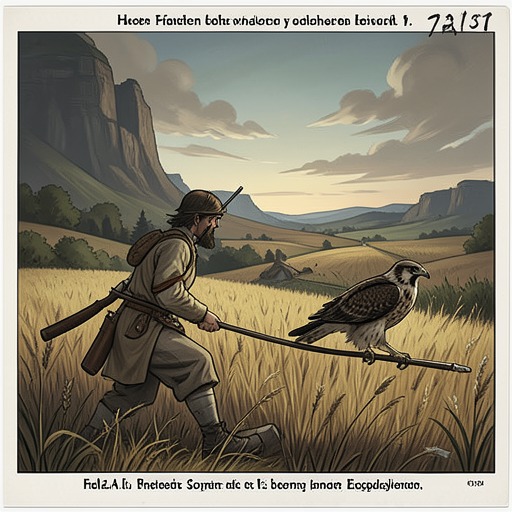
Once Macdonald gives Mabel greater freedom to choose where she flies, the hawk begins making detours to check particular places where a Rabbit or a Pheasant had been the previous week. Macdonald calls this wild superstition and describes it as an instinctive heuristic of the hunting mind. The hawk’s returns are not a human-style map imposed on her; they are a way of navigating shaped by remembered opportunities and the possibility that prey may be there again. In this case, the expectation can work.
Mabel’s pattern echoes Macdonald’s childhood visits to the junction box, the grass-snake site, and the tree where the owl had roosted. Both return to particular places because an earlier encounter gives those places continuing importance. Macdonald describes her own childhood landscape as having slowly become what naturalists call a local patch, glowing with memory and meaning. Mabel is undergoing a comparable transformation of the hill, learning where to turn aside and what earlier experience makes worth checking. The resemblance lies not in identical thoughts but in a repeated practice of attention and return.
A shared, changing place
The hill’s significance rests on the convergence of two kinds of knowledge. Macdonald’s is conscious enough to include observations of weather, ground, animal movement, and the incidents that have marked her walks. Mabel’s appears in the routes and detours of a hunting bird following remembered possibilities. Each has a landscape that is more than a neutral expanse, but neither landscape is wholly private: their histories and movements increasingly overlap.
That overlap gives the concept its intimate force. Macdonald’s permission to fly on the land becomes, through repeated walking and close attention, an experience of belonging without ownership. Mabel, too, is making the hill her own by learning its promising places. The result is not a claim of possession but a shared local patch, formed from memory, observation, and the lives moving through it. What was once simply a stretch of fields becomes a world with waypoints, histories, and anticipated returns—a place that is hers, Mabel’s, and theirs together.